What is intelligence? How is it measured?

Is it something we are born with?
Is it shaped by our environment?
Or is it also, in some ways, a choice?

Intelligence can be knowledge, problem-solving, and the ability to handle practical parts of life—yes, even money.

It can also be self-awareness, creativity, empathy, understanding people, sensing solutions, healthy instinct, and the ability to take something overwhelming and gently break it into doable steps.

There are also many kinds of intelligence—thinking, emotional, creative, social, sensory, practical.

Some people are very logical but cannot read a room to save their lives.
Some feel and understand deeply but struggle to put it into words.
Some notice patterns or shifts long before anyone else realizes something has changed.

And some people who are labeled “intellectually disabled” may learn, process language, or communicate more slowly or differently—yet still carry strong perception, emotional depth, creativity, or problem-solving in other areas.

The ability to speak quickly, clearly, or in ways society finds polished has never truly been the same thing as intelligence.
It is only one form of expression.
But we humans do like to mix those up sometimes.

Sometimes, I believe, intelligence is also…

A choice.

A choice to listen.
To observe.
To stay humble.
To keep learning.
To gently correct how we see things when needed—and then keep learning some more.

To be present.
To really see others and ourselves, even when that seeing feels uncomfortable, tender, or confusing.

And this matters—deeply—because there are people all around us whose intelligence is far greater than what they are often given credit for.

People with cerebral palsy whose bodies or speech do not cooperate with the speed of their thoughts.
Nonverbal autistic individuals who understand far more than others assume.
People with Down syndrome whose emotional insight, relational awareness, or perceptiveness runs deeper than many typically developing adults.
And others with intellectual or developmental differences whose abilities are uneven—strong in some areas, challenged in others, like all of us, just more visible.

When we measure intelligence mainly by speech, speed, or conventional academics, we do not just misunderstand people—we underestimate them.

And perhaps real intelligence, the kind that grows humanity instead of ranking it, asks something quieter of us:

Slow down.
Look again.
Assume depth.
Allow for minds that move differently than our own.

Because intelligence does not always look like fluency.
Or quick answers.
Or polished words.

Sometimes it looks like patience.
Or perception.
Or connection.
Or a mind working clearly behind a body or voice that cannot easily show it.

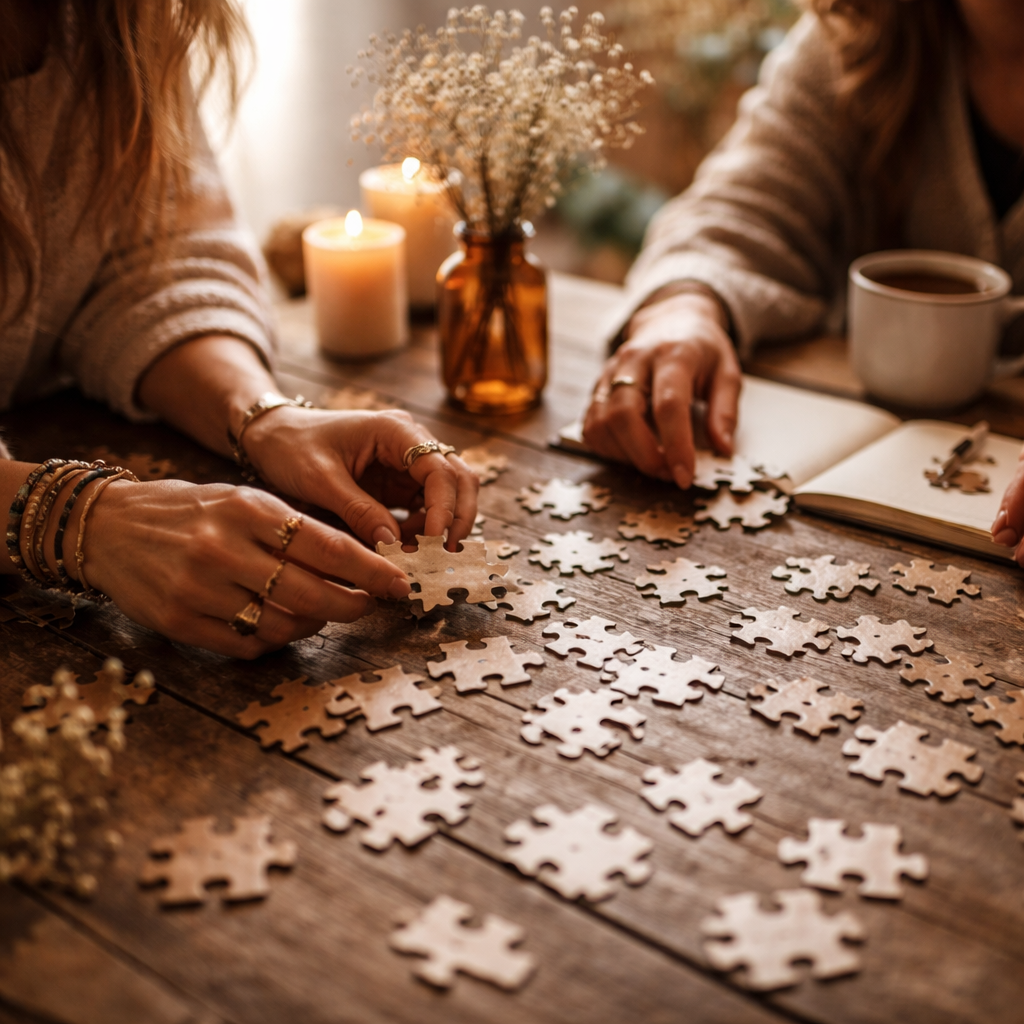
And the picture of intelligence was never missing pieces—only our understanding of where they belong.
The Martyr Looks Within

Call her—she is there.
But she does not have tight circles of friends, or family who check on her daily, or even gently, without her first reaching.
There has been one close beside her, yet even there she has often been the last cup to be touched.

Do not judge her here.
Her cry is not a claim upon you.
She, too, lives somewhere close.
Hear her words, and know your own somewhere near.

She wonders how, though it feels she gives so much—so quickly laying down her own needs to lift another’s—it can feel as though not one soul can return even half the gift she has made so freely available.

She builds others so high that her continuance in their lives becomes almost unnecessary.
And still—where is the gratitude? The thanks?

Does she need it? No.
She only wishes there were even one friend who might see: she gives so much in this one sacred language because it is the very thing she herself lives without.

If she has nothing that answers your need,
she will give you what she does have,
with hope
that it will help you
acquire the rest.

She offers the unsolicited call.
The forgiveness without measure.
The unwavering belief when others have turned away.
The listening ear that may not fully understand, yet trusts your heart, your mind, your soul toward what is right—because that is why she chose you, once and forever, as a friend.
She hushes her desires when they feel like too much.

Everything—everything she strains to pour into the world—is, in truth, what she needs returned.
And it is not much, perhaps.
It does not take much to truly see a person
and place hope, gently, in their hands.

HOPE—
it does not have to remain
just another four-letter word.

She understands
if even that is more than you feel you can spare.
But do not cast your judgment upon her
at a moment she breaks or cannot carry one burden more,
nor fend off one more toxic shard
to bleed through alone.

Perhaps she has given so subtly
her gift—precious and pure—
went unperceived.

She wanted and needed this hope so desperately,
yet the need itself was unseen—
because she taught others
her love did not demand return
or even half reward.

Her earliest wounds were carved
by those who kept score—
credit claimed for every offering,
as if she had done nothing on her own,
as if she had given nothing at all,
only taken, only owed, only ignored.

And now—
has she become their same sad story?
Giving all,
and being forsaken.

So, to break the cycle—

Does she break the love?
Or dare she ask
for boundaries
and more?

Has she truly given all she believes she has—
and more?
Or was it, in all,
a gaslight to draw
a brief audience sigh,
a momentary hush
as others glanced inward
at their own hidden score?

Requiem of My Love

The burden:
to be torn between heart, reason, and self—
three stones in the hand,
shifted back and forth
to balance a scale that will not steady.

My love—
I cannot lift you from the altar of my chest,
cannot unbind you
from the quiet faithfulness
even when love quivered.

I would sooner have my heart
break into a million bright fragments
than abandon a love
that never let go.

There were hours of questioning—
aches I did not author,
wounds I could not name.
I tried, at times,
to set you free.

But you would not go.

You burrowed into my smallest architecture,
nested in the membrane of every cell;
I waxed and waned
to the tide of your nearness.
Without you, nothing to fear—
without you, everything to want.

An anxious current lived in me,
as if some careless spell
had been cast for ruin—
yet still, I stand—we stand.

For with you or without you,
I do not quake.
My love for you is endless—
and this,
I will not forsake.

A love letter to the love within my heart.

Are you living out someone else’s script of love — or writing your own?

On Saints, Sacrifice, and a Poet Who Might Have Started All This.

Every year around this time, everything turns pink.

Suddenly we are all supposed to feel something specific. Romantic. Hopeful. Coupled. Desired. Or at least convincingly unbothered.

And yet, when you look at the origins of Valentine’s Day, it’s… strange.

Before roses and heart-shaped boxes of chocolate that somehow all taste the same, mid-February in ancient Rome meant Lupercalia — a fertility festival involving ritual sacrifice and pairing by lottery. Not exactly soft lighting and handwritten notes. It was physical. Earthy. A little chaotic.

Then Christianity layered itself on top of it. Several Saint Valentines, possibly more than one martyr. Stories blurred. Legends stitched. A priest defying an emperor. A letter signed “from your Valentine.”

It’s hard to separate fact from folklore.

Which feels oddly appropriate.

And then, unexpectedly, comes poetry.

In the 14th century, Geoffrey Chaucer wrote “Parlement of Foules.” In it, birds gather on Saint Valentine’s Day to choose their mates. Whether he meant February 14th specifically is debated. But something shifted there.

Love became literary.

It became courtly. Intentional. Romanticized.

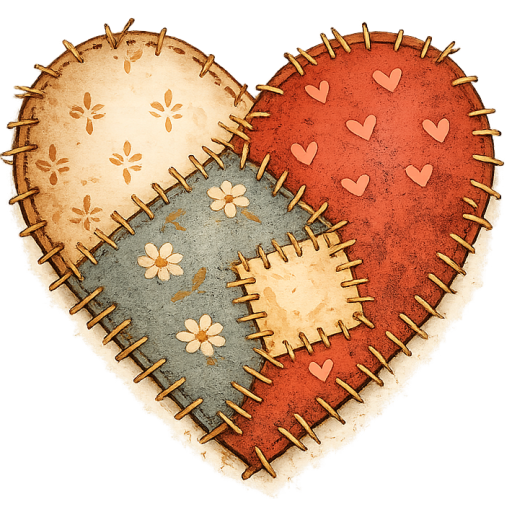
We sometimes act like Valentine’s Day is timeless and sacred, but it’s actually layered — pagan ritual, Christian martyrdom, medieval imagination, Victorian sentimentality, and modern marketing all stitched together.

A patchwork.

And maybe that’s the point.

Love itself is layered. Rarely pure. Rarely simple. Often inherited in forms we didn’t consciously choose.

We grow up absorbing ideas about romance from poems, holidays, movies, expectations. We participate in rituals we didn’t invent. We measure ourselves against traditions that were, in many ways, improvised.

It’s a little ironic.

A holiday rooted in sacrifice and myth now asking us to perform perfection.

And yet.

Somewhere inside all of it, something real still exists.

Two people choosing each other.

Or one person choosing themselves.

To “dare to mend” on Valentine’s Day is not to reject it entirely. It’s to see it clearly. To acknowledge the absurdity without becoming cynical. To recognize that love has always been complicated, layered, human.

Chaucer imagined birds gathering under divine order to find their mate.

Today, we scroll.

Different medium. Same longing.

The question hasn’t changed much over the centuries:

Who am I choosing?

Why am I choosing them?

Am I choosing from fear, pressure, tradition — or from wholeness?

Maybe this is the quieter work of February 14th.

Not the performance.

The reflection.

Not the urgency.

The discernment.

Not the need to prove love exists.

But the willingness to define it intentionally.

Valentine’s Day was never as simple as the cards suggest. And neither are we.

So perhaps the most honest way to honor it is not with grand gestures — but with clarity.

To mend what has been broken.

To unlearn what was inherited without question.

To choose love — if and when we do — with open eyes.

That feels braver to me than roses.

That feels like progress.

That feels like daring.

Progress Over Pressure: Gratitude in My Weight Loss Journey

I want to pause and express gratitude.

I’ve been struggling a bit lately with additional weight loss, and my appetite seems to be creeping back in the wrong direction. But instead of panicking, I’m choosing to take this one day at a time. When my body is ready, I trust the process will find its rhythm again.

So often, we rush ourselves and place unnecessary pressure on our bodies to lose weight quickly—fast, steady, now. 🙋‍♀️

But sometimes our bodies are saying, slow down… take it easy.

And that’s okay.

It’s important to savor how far we’ve already come. I can do so much more than I could before. Even though I still have pain and some limitations, I am miles ahead of where I was last year—and the year before that.

So thank you, body, for holding me together the best you could.

Thank you for continuing to heal.

Thank you, heart, for offering me grace.

Thank you. Thank you. Thank you.

Nighttime Ritual: A Poem

A candle holds the day in amber light,

its small flame breathing slow and kind.

Piano notes fall gently—Mozart-soft—

meeting the steady murmur of running water,

and time loosens just enough

for the body to exhale.

The wick has done its work.

What ailed me rests, at least for now.

I extinguish the flame without regret,

letting darkness arrive as a friend.

With hope, with prayer,

I place tomorrow carefully ahead of me—

asking for blessing,

for protection,

and for a day free from added strain,

from sharp edges,

from unnecessary pain.

Join our newsletter to stay updated