Yesterday was one of those days where nothing felt polished, but everything felt like it was calling me to keep pressing forward.
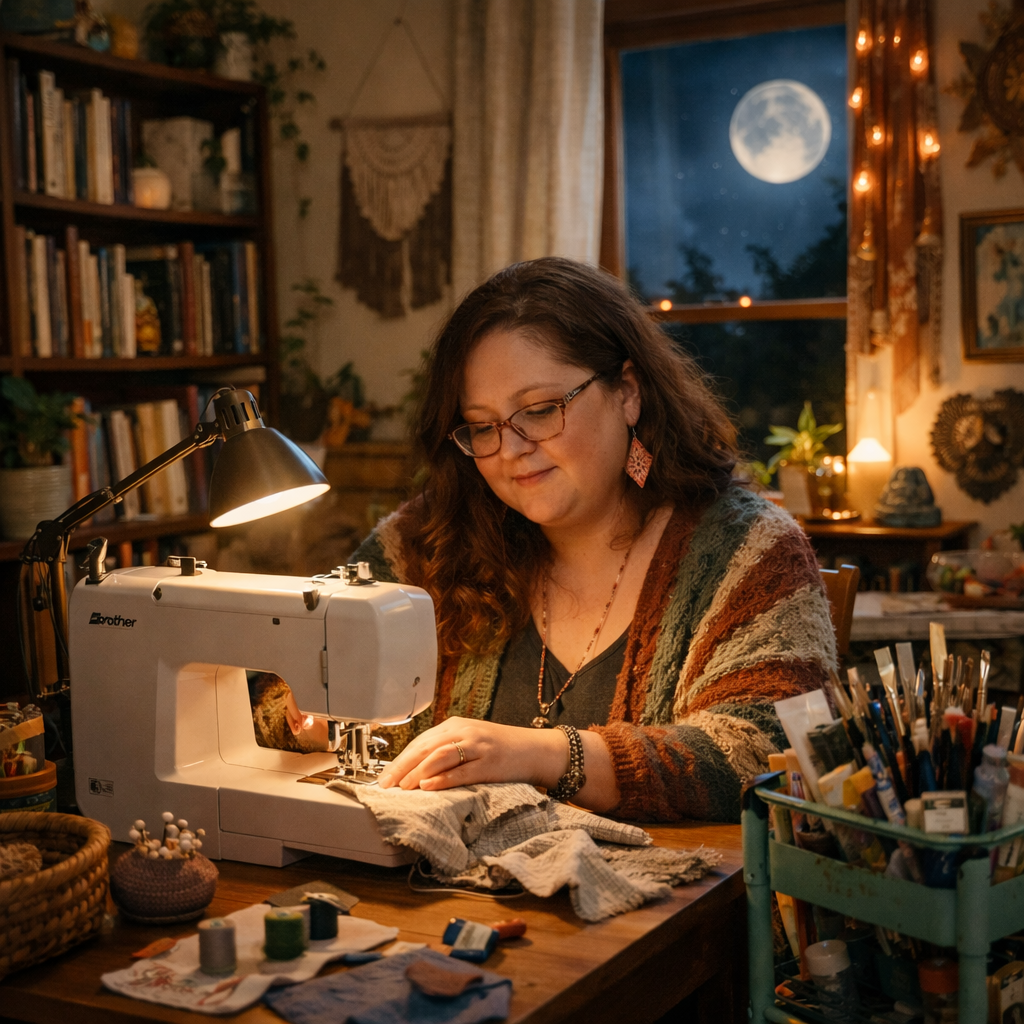
I worked my way through setting up my Brother LS2020 sewing machine—a Facebook Marketplace find that turned out to be a good deal and a lesson in patience and listening to my body and mind. I flipped through the manual, tried a step, flipped back, ripped out threads, and tried again. Between the cold weather, older hands, and the occasional muscle spasm, my fingers started cramping mid-threading. It became clear that pacing, gentleness, perseverance—and possibly some future adaptive tools—were going to be just as important as knowing which lever does what.
Then I tried mending and taking in a dress that was torn, too big, and full of loose seams.
It was… rough. Uneven stitches. Awkward tension. A little “should I be doing this level of sewing on the first day?” energy stitched right in. But when I finished and really looked at it, I felt proud. Not because it looked perfect—it didn’t—but because it could function as a wearable garment again. The repairs, fabric, and seams were far from excellent, but somehow it felt important that it was okay.
Before I even began sewing that evening, I found myself drawn into music—music that stayed with me as I worked.
I watched and listened to Sofia Isella and once again felt that familiar mix of being drawn in, unsettled, slightly repelled… and then pulled closer. Her work isn’t meant to soothe. It pokes. It exposes. There’s a theatrical darkness to it, but also an intelligence and discipline underneath that makes it hit harder.
Part of that comes from her background. Sofia is classically trained, a violinist since childhood, and it shows—not just in the occasional presence of strings, but in how she structures tension. Her father, Adam Isella, is a composer and violinist, and you can feel that lineage in her command of mood and dynamics. This isn’t chaos for chaos’ sake. It’s deliberate. Controlled. Almost surgical.
Songs like “Everybody Supports Women” don’t resolve neatly. They sit in contradiction. They make you uncomfortable and then dare you to ask why. I notice myself wanting to turn it off—and then wanting to rewind.
That same push-pull showed up again when I discovered Ren.
You don’t casually discover Ren. You encounter him.
His song “Hi Ren” feels like an internal argument you’re not supposed to overhear. It’s raw, theatrical, self-aware, and deeply human. And once you know his story, it lands differently. Years of severe illness—later understood to be connected to Lyme disease and neurological complications—misdiagnoses, chronic pain, cognitive struggles, and long stretches where his life and career stalled completely.
Instead of cleaning that up, he built from it.
Songs like “Chalk Outlines” and “Sick Boi” don’t pretend healing is linear or pretty. They don’t tie a bow on suffering. They leave the stitches visible. They let the listener sit in the unresolved places—the ones we usually rush past.
And that’s when it clicked for me.
The reason this music pulls me in and pushes me away is the same reason I felt something while mending that dress. Both require you to stay with something not quite right. To sit with it. Not pretend everything is okay—or that you are okay. Just work with it carefully, imperfectly, honestly.
Mending isn’t about making something completely brand new again.
It’s about making something functional—or maybe even visually striking in a new way—without rushing the process.
That unsettled feeling—the one that lingers after the song ends or when you notice a crooked seam—that’s where the thinking happens. That’s where attention sharpens. That’s where something real shifts.
I didn’t master sewing today.
I didn’t fully understand the music.
But I stayed present with both.
And somehow, that felt like the point.
Is there something in your life right now that’s asking for patience instead of fixing?
What’s one thing you’re learning not to rush? Scroll down to the far end of the page if you would like to leave a comment below.