
“The Ones Who Get Away With It”
It’s a quiet kind of sadness—
That very few people who hurt others ever face real consequences. The ones who raise a hand, or act violently, sometimes get caught. But what we don’t talk about enough are the quieter ones: the gaslighters, the stonewallers, the manipulators, the people who play the “victim” and The Saint. They can hurt just as much—sometimes more—and yet life moves on for them, because they stay just within the rules, or twist them to their favor.
That reality can linger in the mind.
You may feel differently, and that’s okay.
Here’s how I see it:
We’ve all made mistakes.
We’ve all hurt others, knowingly or not.
Some of us notice it. We own it. We try to do better.
Others don’t.
They dismiss the hurt. They call the victim “overly sensitive” or “imagining things.” They fail to acknowledge the impact of their actions.
Still, I like to believe in something greater—a Universe, a God, a gentle force that sees everything.
That belief keeps me humble.
I know I’m not perfect.
But I try. I try to break patterns I’ve seen or experienced.
That’s why, even though I love children, I chose not to have my own.
Because no child deserves to grow up in a home where unresolved hurt lives between the adults.
Parents make mistakes—it’s human.
But those who never admit them? Their silence leaves marks that last.
Even small things—disrespect between parents, subtle dismissals—can shape a child’s world.
Children carry pieces of both parents, whether we realize it or not.
So it’s not just about our own pain—it’s about the lives we touch.
That’s my gentle guidance.
And if someone says, “You’ve never been a parent,” I would say:
I have mothered many.
They weren’t my children by birth, but they were souls in need of care—and I showed up for them.
When I pass, maybe only a few will be there.
But I’ll go knowing this:
I tried. I loved. I made a difference.
And that brings me peace.
Image Description for the Visually Impaired or those interested in understanding why this image was attached:
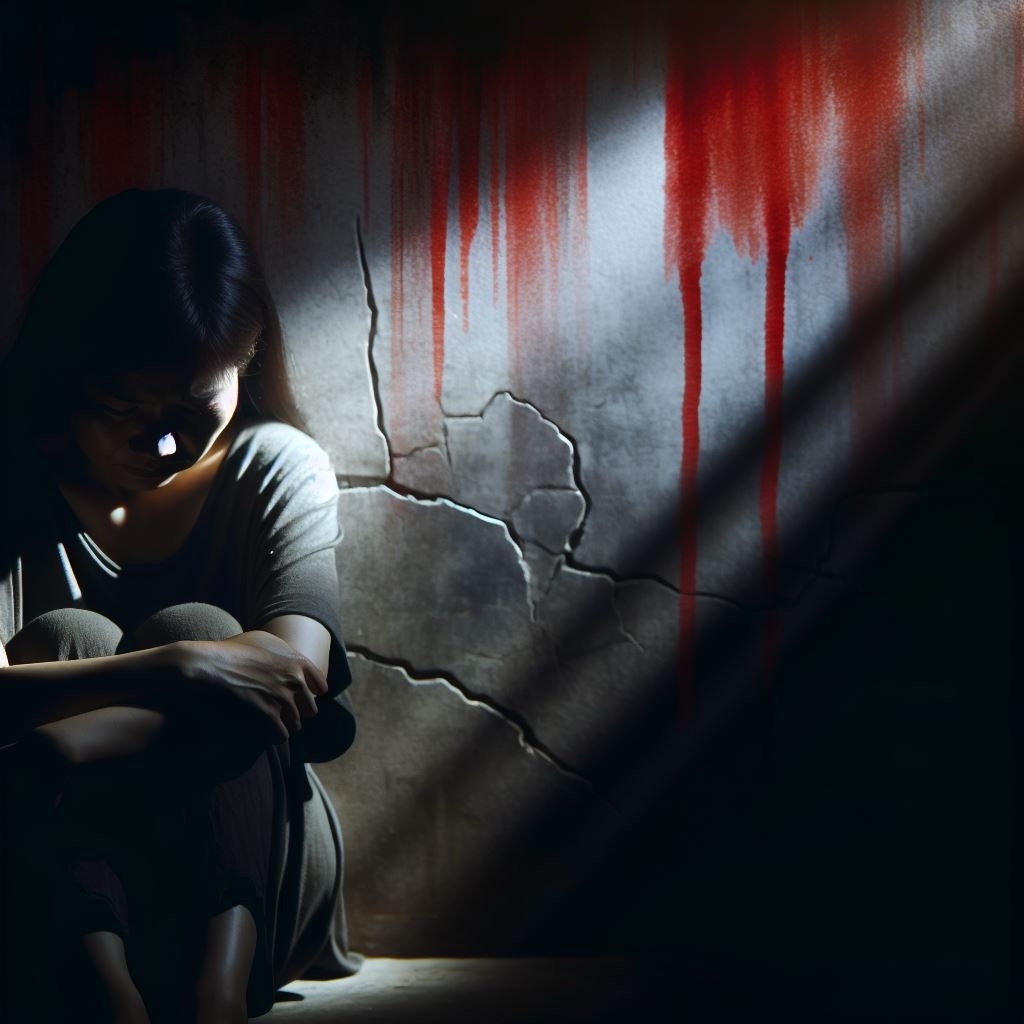
In a dimly lit, shadow-heavy room, a woman sits hunched over on the floor. Her posture is broken—shoulders collapsed inward, head bowed low, arms wrapped around herself as if trying to hold together what’s left. Her long hair falls forward, partially obscuring her face, but the faint light source—soft and subtle—catches the glisten of tears in her eyes. The light gently illuminates her face and shoulders, casting deep shadows that emphasize her isolation and emotional weight.
The background is stark and haunting: a cracked, aged wall looms behind her, streaked with vivid red lines that drip downward like bleeding memories or emotional scars. The red streaks are abstract—neither blood nor paint—but they evoke trauma, rage, and unresolved pain. The wall itself feels cold, almost alive, as if it’s witnessed everything she’s endured.
The overall mood is heavy, raw, and deeply emotional. The darkness doesn’t just surround her—it presses in. Yet the faint light suggests a sliver of hope, or at least awareness. She’s not invisible. She’s seen. And that matters.
*edited by author on 1/18/26