
Is it something we are born with?
Is it shaped by our environment?
Or is it also, in some ways, a choice?
Intelligence can be knowledge, problem-solving, and the ability to handle practical parts of life—yes, even money.
It can also be self-awareness, creativity, empathy, understanding people, sensing solutions, healthy instinct, and the ability to take something overwhelming and gently break it into doable steps.
There are also many kinds of intelligence—thinking, emotional, creative, social, sensory, practical.
Some people are very logical but cannot read a room to save their lives.
Some feel and understand deeply but struggle to put it into words.
Some notice patterns or shifts long before anyone else realizes something has changed.
And some people who are labeled “intellectually disabled” may learn, process language, or communicate more slowly or differently—yet still carry strong perception, emotional depth, creativity, or problem-solving in other areas.
The ability to speak quickly, clearly, or in ways society finds polished has never truly been the same thing as intelligence.
It is only one form of expression.
But we humans do like to mix those up sometimes.
Sometimes, I believe, intelligence is also…
A choice.
A choice to listen.
To observe.
To stay humble.
To keep learning.
To gently correct how we see things when needed—and then keep learning some more.
To be present.
To really see others and ourselves, even when that seeing feels uncomfortable, tender, or confusing.
And this matters—deeply—because there are people all around us whose intelligence is far greater than what they are often given credit for.
People with cerebral palsy whose bodies or speech do not cooperate with the speed of their thoughts.
Nonverbal autistic individuals who understand far more than others assume.
People with Down syndrome whose emotional insight, relational awareness, or perceptiveness runs deeper than many typically developing adults.
And others with intellectual or developmental differences whose abilities are uneven—strong in some areas, challenged in others, like all of us, just more visible.
When we measure intelligence mainly by speech, speed, or conventional academics, we do not just misunderstand people—we underestimate them.
And perhaps real intelligence, the kind that grows humanity instead of ranking it, asks something quieter of us:
Slow down.
Look again.
Assume depth.
Allow for minds that move differently than our own.
Because intelligence does not always look like fluency.
Or quick answers.
Or polished words.
Sometimes it looks like patience.
Or perception.
Or connection.
Or a mind working clearly behind a body or voice that cannot easily show it.
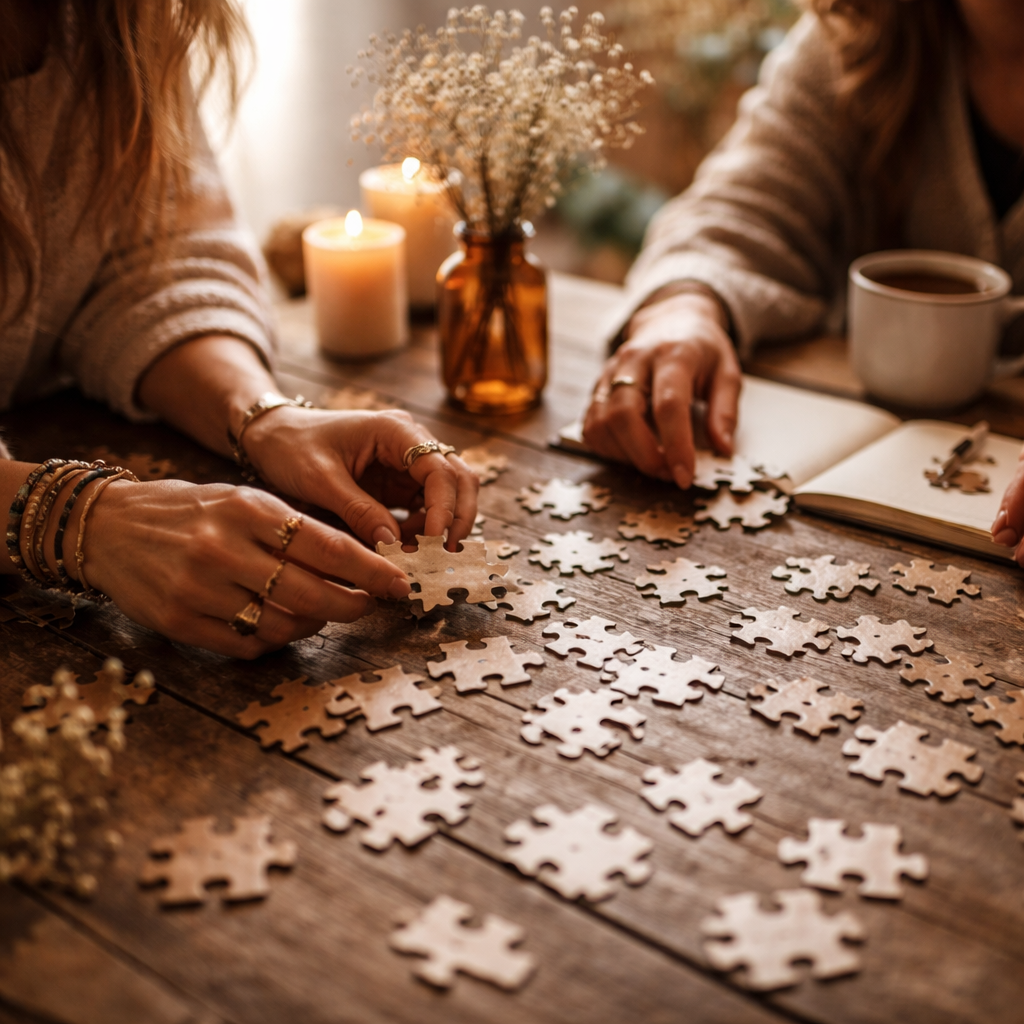
And the picture of intelligence was never missing pieces—only our understanding of where they belong.